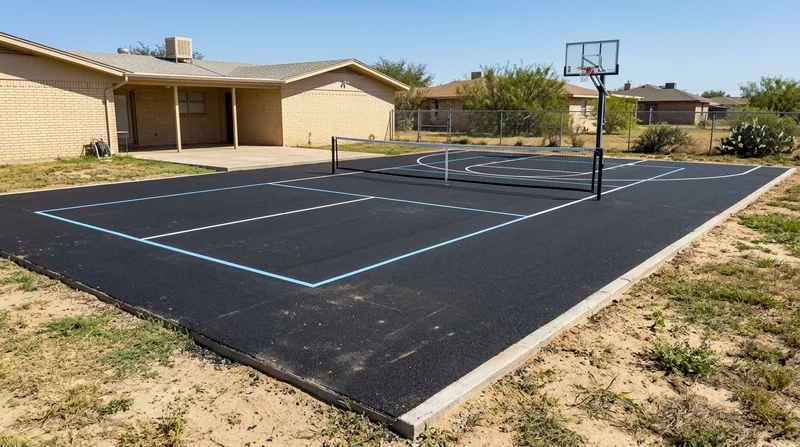




Sports Court & Path Paving in Laredo demands a foundation that holds up under South Texas heat and the sudden downpours that can undercut a poorly built court in a single storm. Laredo's brush-country ground, caliche subsoil, and long summers mean that any tennis court, basketball court, or walking path needs a compacted base and proper pitch to shed water before the sun softens the mat or moisture weakens the soil below. We grade and compact the base, then finish with hot mix asphalt so the court plays flat through triple-digit heat and flash floods. Since 2014, we have built courts and paths across Laredo and the surrounding Webb, La Salle, and Jim Hogg county communities, from residential lots in the historic neighborhoods near the Rio Grande through the subdivisions pushing north toward Rio Bravo and El Cenizo. A well-built court is an investment that pays back in playability and durability, and it starts with the ground underneath.
Why Sports Court & Path Paving Matters in Laredo's Climate
Laredo's heat and variable moisture are the twin enemies of an asphalt court. When temperatures climb past 100 degrees, an undersized or poorly compacted base allows the mat to rut under foot traffic and wheeled equipment. When summer storms arrive in bursts, water that cannot drain away will seep under an improperly pitched surface and soften the caliche or sandy loam below, causing settlement and cracking. A court built right the first time avoids costly repairs in three to five years.
- We compact the base in layers to eliminate voids and prevent settling under the weight of the asphalt mat.
- We pitch the court at a quarter inch per foot so water sheds toward the edges and never pools on the playing surface.
- We use hot mix asphalt laid at the correct temperature and thickness to resist rutting and maintain a true, playable surface through Laredo summers.
- We verify drainage around the perimeter so that flash floods and irrigation runoff move away from the court, not under it.
These steps cost more upfront but deliver a court that plays true and lasts.
Key info: Laredo's caliche and clay subsoils swell and shrink with wet and dry cycles, so a court without proper compacted base and edge support will crack and shove within a season or two. A quarter-inch pitch per foot is not optional in this climate, it is structural.
For more on how we prepare surfaces for durability, see our Gravel Driveway Installation and Grading page, which covers the same base-prep principles that underpin every court we build. The City of Laredo and other municipalities in the area may have rules about drainage, impervious surface limits, and utility clearances, so verify with your local building department before work begins.
How We Build a Sports Court or Path in Laredo
The work unfolds in stages, each one critical to how the court will perform. We start with a site visit to understand the soil, existing drainage, and any utilities that may be buried. We then grade and compact the base, set the pitch, and lay hot mix asphalt at the proper thickness and temperature. The whole process takes planning and care, not just pouring and leaving.
- We call Texas 811 to locate all underground utilities before any excavation or grading begins.
- We remove and haul away any unsuitable material, such as loose fill or organic debris.
- We bring in compacted aggregate base, typically limestone or recycled asphalt millings, and roll it in layers.
- We proof-roll the base to verify compaction and identify any soft spots that need rework.
- We set the final grade and pitch so water drains away from the court and surrounding structures.
- We lay hot mix asphalt at the correct temperature and thickness, typically 2 to 3 inches for a residential court.
- We allow the mat to cure before opening the court to traffic or play, usually 24 to 48 hours depending on weather.
This methodical approach takes longer than a quick pour, but it is the only way to build a court that will not fail.
Example: A homeowner in Las Haciendas wanted a basketball court on a lot that had been caliche and gravel for years. We excavated, brought in 4 inches of compacted limestone base, verified the pitch with a level, and laid 2.5 inches of hot mix. The court opened in 48 hours and has played true for three seasons with no rutting or cracking, even through the 2022 summer heat.
For more detail on the grading and base work that makes any paving job last, visit our Asphalt Driveway Paving and Installation page, which covers the same compaction and drainage principles.
Sports Court and Path Paving Methods in Laredo
| Approach | Description | Best for |
|---|---|---|
| New Court on Prepared Base | Excavate, grade, compact aggregate base in layers, proof-roll, set pitch, lay hot mix asphalt 2.5 to 3 inches. | New courts on raw caliche or gravel, or replacement of a failed court. |
| Overlay on Existing Court | Mill or mill-free overlay of 1.5 to 2 inches of hot mix over a sound existing mat to restore surface and correct minor pitch issues. | Courts with surface cracks and ruts but a solid base underneath, typically 5 to 10 years old. |
| Patching and Spot Repair | Cut out and remove failed sections, prepare the base, and fill with hot mix asphalt to match the surrounding surface. | Isolated potholes, alligator cracks, or soft spots on otherwise sound courts. |
| Full-Depth Replacement | Remove the entire asphalt mat and base, excavate and regrade to proper pitch, install new compacted base, and lay new asphalt. | Courts with extensive alligator cracking, base failure, poor drainage, or settling that cannot be corrected by overlay. |
| Walking Paths and Connecting Aprons | Grade, compact base, and lay asphalt at 1.5 to 2 inches to create a durable walking surface that sheds water and resists settling. | Paths connecting a court to a driveway or house, or standalone walking surfaces in parks and subdivisions. |
Sports Court and Path Paving Cost in Laredo: What to Expect
The cost of a sports court or path paving job depends on the size of the surface, the condition of the existing ground, and the scope of base preparation required. A new court on prepared base typically starts at $8,500 for a small residential half-court, while a full-size court or a job that requires significant excavation and regrading will cost more. An overlay on an existing sound court costs less than full replacement, while patching a few potholes is the least expensive option if the base is still solid.
Factors that affect the price include the size of the court in square feet, the depth and type of base material needed, the thickness of the asphalt mat, site access and staging, and the distance from our yard. A site that requires heavy excavation, poor drainage correction, or utility relocations will be at the higher end of the range. We provide a written estimate with tonnage and thickness specifications so you understand exactly what you are paying for.
For a detailed look at how we price different types of paving work, visit our Pricing Overview page. We recommend getting 2 to 3 estimates from local contractors so you can compare scope, materials, and price. The lowest bid is often the one that cuts corners on base preparation, which is where failure begins.
Sports Court and Path Paving Near Me: What Laredo Homeowners Should Know When Hiring a Contractor
Hiring the right contractor for a sports court or path is as important as the materials you choose. A reputable local paving company will provide a written estimate, explain the work in detail, verify permits and regulations with your city or HOA, and stand behind the work with a reasonable warranty on labor. Before you book, verify that the contractor carries liability insurance and can provide references from recent jobs in your neighborhood.
Ask your contractor to confirm that all permits required by the City of Laredo or your municipality are included in the scope, and that they will pull those permits on your behalf. If your home is in an HOA, check the architectural standards to confirm that asphalt is an approved material and that any color or finish requirements are met. Request a written contract that specifies the materials, thickness, compaction method, and timeline so there are no surprises.
Be wary of unsolicited door-to-door offers, especially from crews with out-of-state plates or a price that is too good to be true. The single strongest indicator of a reputable local contractor is a verifiable local address and a history in the community. Ask for references, check them, and ask to see photos of completed work. A contractor who cannot or will not provide these is not worth your money.
For help navigating the estimate and hiring process, contact us at (956) 857-9145 for a free, no-obligation estimate. We are happy to answer your questions and explain what a quality court should include.
Sports Court & Path Paving in Laredo: Pricing Guide
| Service | Price | Details |
|---|---|---|
| Small residential half-court (1,200 to 1,500 sq ft) | Starting at $8,500 | Includes base prep, compaction, pitch, and 2.5 inch hot mix asphalt mat, new ground or sound existing base |
| Full-size residential court (2,000 to 2,500 sq ft) | Starting at $12,000 | Includes excavation, compacted aggregate base, proper pitch, and 2.5 to 3 inch hot mix asphalt, typical Laredo residential lot |
| Overlay on existing court (1,500 to 2,500 sq ft) | Starting at $5,500 | Includes 1.5 to 2 inch hot mix overlay, mill-free or milled surface, assumes base is sound and pitch is acceptable |
| Walking paths or connecting aprons (500 to 1,000 sq ft) | Starting at $3,000 | Includes base prep, pitch, and 1.5 to 2 inch asphalt, typical residential path from driveway to court |
| Complex or full-depth replacement with utilities or poor drainage | On estimate | Excavation, Texas 811 locate, base rework, drainage correction, and new asphalt require site visit and measurement |
| Estimate and consultation | Free | Site visit, measurement, written estimate with tonnage and thickness specs, response within 24 hours |
Indicative pricing, the exact cost depends on square footage, finish, and site access. Free personalized estimate within 24h at (956) 857-9145.


